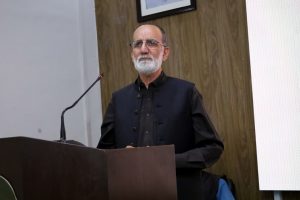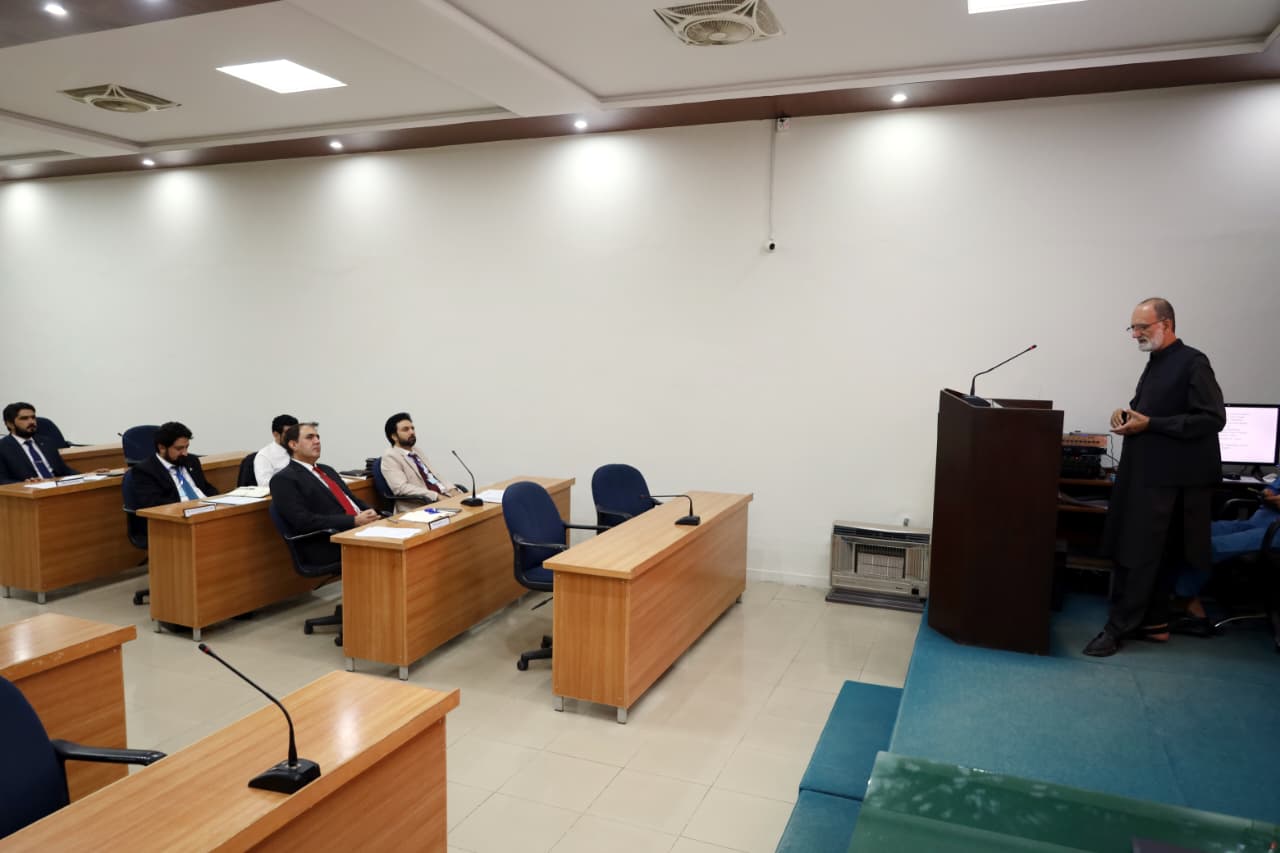
Pakistan Provincial Services Academy (PPSA), Peshawar, has been imparting pre-service/in-service training to the officers/probationers of the provincial civil services of all four provinces of Pakistan, including Gilgit-Baltistan, since 1969. Mr. Muhammad Taj Hamid, Chief Instructor, PPSA, invited Prof. Dr. Zahid Anwar, CEO, PDRE, & former Pro Vice-Chancellor, University of Peshawar, to deliver a lecture to PMS officers at the Academy on 19th October, 2026, on “CPEC: Challenges and Potential for Provincial Governments.” Professor Zahid Anwar, in his presentation, highlighted that the China–Pakistan Economic Corridor (CPEC), the flagship project of China’s Belt and Road Initiative (BRI), represents a major milestone in Pakistan–China relations and offers an important pathway towards regional economic integration, industrial development, and shared prosperity. Built upon decades of political trust and strategic cooperation, the partnership between Pakistan and China has evolved from defense and diplomatic collaboration towards broader economic cooperation. CPEC seeks to connect China’s Xinjiang region with Pakistan’s Arabian Sea coast through Gwadar, strengthening regional connectivity and creating opportunities for trade, investment, and economic development.
Phase I of CPEC primarily concentrated on energy generation, transport infrastructure, telecommunications, and connectivity. The development of power projects, highways, transmission networks, and Gwadar Port helped address Pakistan’s energy shortages and improve its infrastructure. CPEC has attracted approximately US$62 billion in approved investment, of which around US$25.93 billion has been realized. Its achievements include approximately 8,000 megawatts of additional electricity-generation capacity, 261,000 jobs, and significant improvements in road connectivity. These investments established an essential foundation for the next stage of cooperation.
Phase II, formally advanced in 2025, marks a strategic shift from infrastructure development towards industrialization, productivity, innovation, and export-led growth. The CPEC Action Plan 2025–2029 identifies five priority corridors: Growth, Livelihood, Innovation, Green Development, and Openness. Its principal areas of focus include business-to-business cooperation, Special Economic Zones (SEZs), modern agriculture, mineral development, human-capital formation, digital technologies, renewable energy, and regional trade. The four priority SEZs are Rashakai in Khyber Pakhtunkhwa, Dhabeji in Sindh, Allama Iqbal Industrial City in Punjab, and Bostan in Balochistan. Their success will depend on reliable utilities, efficient regulation, investment facilitation, technology transfer, and the development of a skilled local workforce.
A defining feature of Phase II is the growing importance of provincial governments. Under Pakistan’s 18th Constitutional Amendment, key areas—including industry, agriculture, education, health, environment, and minerals—fall substantially within provincial responsibility. Whereas Phase I was largely driven by federal infrastructure initiatives, Phase II requires provincial administrations to become active partners in economic planning, implementation, and investment promotion. Khyber Pakhtunkhwa can benefit from the 884-megawatt Suki Kinari hydropower project and the Rashakai SEZ, which has the potential to generate substantial employment. Baluchistan’s opportunities center on Gwadar Port and the Bostan SEZ; Punjab’s on Allama Iqbal Industrial City; and Sindh’s on Dhabeji SEZ and its energy and maritime infrastructure.
The literature on CPEC identifies the following key challenges and proposes corresponding measures to address them. Nevertheless, important challenges remain, including weak federal–provincial coordination, delays in providing utilities to industrial zones, land disputes, fiscal constraints, security concerns, environmental risks, and inadequate technology transfer. These obstacles require practical institutional reforms. The Council of Common Interests can strengthen coordination; effective provincial CPEC secretariats can be established; genuine one-window facilities for investors can be provided; litigation-free land banks can be developed; local employment commitments can be enforced; and technical education can be aligned with industrial requirements. The CPEC Consortium of Universities, comprising 134 Pakistani and Chinese institutions, can play a vital role in research collaboration, vocational training, and technology transfer.
In conclusion, the success of CPEC Phase II will depend not merely on the completion of infrastructure but on its ability to generate productive industries, quality employment, agricultural improvements, technological innovation, and tangible benefits for local communities. Provincial governments must therefore move beyond the traditional role of implementing federally designed projects and become co-designers of economic development. With effective coordination, transparent governance, private-sector participation, and meaningful engagement with local communities, CPEC can strengthen Pakistan’s productive capacity and position the country as a regional hub for trade, investment, and economic cooperation. The session concluded with an interactive question-and-answer session, followed by a vote of thanks to the distinguished speaker.